

This blog post is for everyone with a professional US Seller account looking to expand his/her business into Europe, and more specifically into Germany.
We will explain which steps are necessary, what you have to know about the german market, and how you can import your products hassle-free into the EU. We will also give out a recommendation on who could help you set foot onto Amazon.de if you don’t want to take the risk of doing it all by yourself.
Why you should expand to Amazon.de

The german e-commerce market has been strong ever since. Of course it is in no way comparable to the US-market, simply because of the different size and population count of both countries – but if you think about expanding and getting hold of the European purchasing power, Amazon.de is the best place to start.
In the global marketplace ranking, Amazon.de comes right behind Amazon.com, even though it only holds a 5% share of the global gross merchandise volume (while the US holds 52%). It is estimated that there are about 400.000 active sellers on the platform and 500 million monthly visitors who complete on average 39 orders a year with a mean basket value of $46.
There are a few key advantages when selling your products on Amazon.de:
- Competition in most niches is not as aggressive as in the US
- Products reach better organic rankings faster
- The advertisings CPCs are usually lower
- Return rates are moderate compared to the US
- Customers can be less price-sensitive
- Customery loyalty is higher
Let’s compare typical customer behaviour between the two countries:
| Behavior | USA | Germany |
|---|---|---|
| Impulse buying | Very high | Moderate |
| Price sensitivity | High | Moderate |
| Brand loyalty | Moderate | Higher |
| Review importance | Extremely high | Very high |
| Return rate | Very high | Lower |
| Delivery expectations | Same day / 2 days | Fast but slightly more tolerant |
| Preferred product style | Trend-driven | Functional & quality-focused |
It is well-known that Germany boasts immense purchasing power, as it is Europe’s largest economy. On top of that, Amazon.de acts like a „gateway“ to the rest of Mainland Europe with even more lucrative markets. As soon as you have built a presence in Germany and stored your inventory in Amazons fulfillments centers on german ground, you can easily access the whole European market and fulfill orders across France, Italy, Spain – thanks to the Pan-EU FBA program. But more on that later…
Selling on Amazon.de as a US-based seller is, on most cases, well worth it.
We recommend expanding to the german market, if:
- You already sell successfully on Amazon US → expansion is a logical next step
- Your product has decent margins → you stay profitable despite import duties
- Your product is lightweight/small → best / cheapest for shipping
- You can handle administrative paperwork and tax compliance
- Your products are attractive to German buyers
|
Which kind of products are especially popular on Amazon.de? – Electronics and Smart Tech |
You have to consider cultural differences before wanting to sell your products to german customers. An easy example would be accessoires for American Football fans: Even though Germans celebrate different cultures and enjoy watching and doing sports, they are much more into soccer, handball and volleyball. Other examples would be Root Beer or sweetened Peanut Butter which are way less popular in Germany. The same could go for fashion trends, media, outdoor accessoires, lifestyle products, and so on.
So please do your market research to assess whether your products have a demand in Germany or if they could even fill a market gap.
What makes expanding to Amazon.de complicated

Initially, expanding to Germany from the US might seem like a pretty straightforward step which simply includes activating Amazon.de, translating your listings into german and shipping your inventory.
However, you will be surprised to find out that things work a little differently in Europe. Here are the major differences:
- There is Value Added Tax (VAT) instead of Sales Tax, and it is a bit more complicated
- You will need to understand the system of Import VAT, Sales VAT and VAT returns
- You need a german VAT number as soon as you store physical inventory on german ground
- You need to do regular reportings and annual tax filings requiring a specialized EU accountant
- You need to report VAT in your invoices
- EU Compliance Laws are much stricter and you have extended producer responsibilities
- Depending on product categories, there are detailed regulations concerning certification, documentation, safety etc.
- Products with missing labels or warning signs can get suspended
- You need to comply with packaging and recycling laws, get a LUCID number and maybe a WEEE number (electronics)
- Consumers have extensive rights and different expectations
- Consumers enjoy a 14-day right of withdrawal and certain warranty rights.
- Consumers expect accurate technical information, full disclosures and perfect language. They are repelled by machine translations and exaggerated marketing
- Consumers research more carefully, compare specifications, value quality, durability and reliability, trust certifications
- Little „mishaps“ can lead to legal warnings
- Incorrect product claims, missing legal disclosures, misleading discounts or missing VAT info can get you in the crossfire with lawyers and authorities
- You need to be careful with „american-style“ health claims, environmental claims or performance claims
- Trademarks and Product Restrictions are different
- You will need to register a german or european trademark to protect your brand outside of the US
- Especially cosmetics, supplements, electronics, toys or chemicals might face tighter restrictions in the EU or even be illegal
So pretty soon into the process, you realize that you will need to inquire the services of accountants, consultants and Amazon agencies on top of the obvious logistics services by freight forwarders and customs brokers.
How To Start Selling Globally (US → EU)

1. Set up an European Seller Account
Click in your Seller Account on Inventory → Sell Globally → European Seller Account → Register Now. Now you have access to all European Marketplaces, but you can activate single countries like Germany.
2. Translate and Optimize Listings
German customers prefer shopping in their native language. But if you really want to stand out, you don’t just translate your US listings: You research the most impactful german keywords, understand local search behaviour, make a competitor analysis for the german market, and adjust your listings accordingly. Also pictures need to be adjusted in case they contain any text or strong cultural symbolism.
For this step, Amazon offers the „Build International Listings“ tool free of charge to sellers. With this tool, your listings from Amazon.com are automatically translated into German and are ready to go live after your careful review.
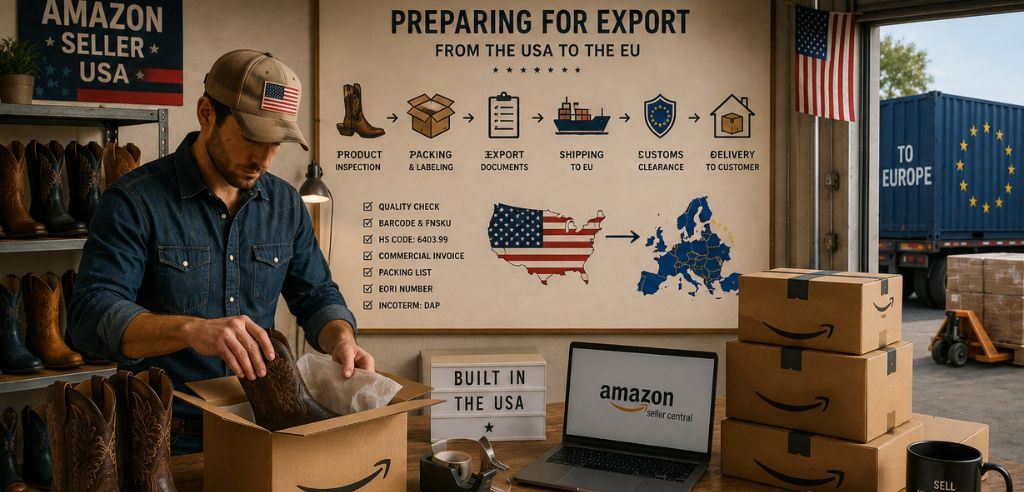
Note: If you sell „typical American products“ like cowboy boots, native american jewelry, bbc sauce, letterman jackets etc., it makes sense to leave your listing a little bit „americanized“ and specify that your products are original American Imports. For day-to-day consumer goods with no specific cultural value, make sure your listing does not show any american influence and is fully optimized to fit german purchasing behaviour.
3. Get an EORI number and VAT number
Everyone who moves goods across borders within Europe needs an EORI number (Economic Operators Registration and Identification). This number is used for customs declarations and import/export documentation.
If you use local FBA or Pan-EU to make your products available in Germany, you need to comply with german tax obligations and apply for a VAT number. I strongly advise you to use a german tax consultant for your declarations as these can get complicated!
If you store your products in the US and ship individual parcels to Germany when ordered, you don’t need a VAT number.
4. Comply with Extended Producer Responsibilities
The LUCID number is something specific to Germany which many foreign sellers aren’t aware of. Germany has strict packaging regulations in place and everyone who sells packaged products there must register with the Lucid Packaging Register, purchase a license for the type and amount of packaging to be used, and regularly report statistics to the system. The LUCID number needs to be reported to Amazon.
But it’s not only the packaging: If you sell electrical and electronic equipment, you need to get a WEEE-number to display on all items and fulfill your extended producer responsibilities, which include taking care of the end-of-life recycling and disposal of your products, as well as submitting regular reports.
5. Manage Prices and Payments
Also, you mostly likely can’t just convert your prices from Dollars into Euros if you really want to have a competitive advantage. Research prices on the german market and don’t forget about your margin in order to find the lowest possible price in Euros that still leaves you with a profit.
TIP: When using the Build International Listings tool, you can activate a special pricing rule called “Same as the source marketplace, adjust for taxes and fees”. Then your $-prices and your €-prices will be synchronized, but the €-prices will result a bit higher to reflect fulfilment fees, tax rates, and exchange rate.
This allows you a quick set-up. However, most sellers find that the automatically adjusted prices are either not competitive or not profitable, and eventually switch back to manual pricing.
You can avoid high bank conversion fees by using the Amazon Currency Converter for Sellers or a third-party international transfer service (like Wise or Payoneer) to easily transfer Euros directly to your business bank account in the US.
|
Remember that European VAT works different than US sales tax. The 19% Value-Added-Tax is always included in the displayed price and not charged additionally to customers! |
6. Meet the Expectations of German Customers
Germans can be a tough audience. Their focus on quality and value-for-money is deeply rooted in their purchasing behaviour. They usually take their time to analyse, compare and read through the reviews before making a bigger purchase. On the other hand, they love to make big orders and then return anything they are not totally convinced of.
Germans generally expect:
- Fast delivery within 1-2 days
- Good documentation / invoices
- Clear German-language listings → they don’t trust listings with spelling errors or weird wording
- Favourable return policies
- Realiable and trustworthy sellers / brands
- Excellent customer service
Whereas US shoppers react more strongly to visuals and branding, buy more impulsively and respond better to discounts and PPC ads, Germany can be perceived as a tough audience. It is best to work together with a german-based Amazon agency that understands the market and the culture if you seriously want to expand your business to Germany.
Expanding your business from Amazon US to Amazon Germany can significantly boost your sales and market reach. However, navigating the complexities of this expansion can be challenging. So let’s explore the different possibilities to make your products available to German customers.
How to get your products from the US to Germany
Whoever buys your products on Amazon.com, can have them shipped to their home country by paying an additional fee for international shipping and import which Amazon will charge upon checkout. However, the amount of Germans looking for products on amazon.com will be minimal. If you really want to reach German customers, you need to be present on Amazon.de.
You have two main options when it comes to importing your products into Germany:
- You can either ship your products over to Germany every time a purchase was made (FBM), or
- You can build up a physical inventory on german ground (FBA).
If you choose to store your products in Germany, a German VAT registration is required. VAT ist called „Umsatzsteuer (USt.)“ in german.
Remote Fulfilment, a very popular logistics solution offered by Amazon, is not available for intercontinental transfers. US Sellers can use Remote Fulfilment to sell their products in Canada, Mexico and Brazil, but not in Europe.
Logistics solution #1: Local Inbounding

If you wish to pay local FBA rates as highlighted in the cost overview above, you need to ship your products from your warehouse in the US (or directly from the production site in China) to a german Fulfilment Center. There are over 20 fulfilment centers spread across the nation, so you have plenty of choice.
The import into the EU is not handled by Amazon. So you need to use a reliable freight forwarder („Spedition“ in german) and also a customs broker that takes care of the customs clearance at the border. They will pay all the import duties on your behalf.
Here are a few providers you could use:
You have the choice between:
- Air Freight
- takes usually 5-12 days
- is a beginner-friendly option for smaller quantities and non-bulky products
- can make your margins suffer as it is quite expensive
- Sea Freight
- shipment in containers (can also be shared with others when you choose LCL instead of FCL)
- via ports of Hamburg, Bremerhaven, or Rotterdam
- takes usually 2-5 weeks
- much cheaper per unit and the go-to for scaling brands
- best for heavy / bulky goods and large quantities
|
Pro Tip: Use a 3LP or Prep Center within Germany Third-party logistics providers receive your inventory before Amazon does. They inspect everything and can relabel or repackage your products before they go to the german Fulfilment Center – with the aim of reducing risk, rejections and unnecessary charges. Also they store overflow stock, manage returns and redistribute inventory, so they act as a „buffer warehouse“. |
For taking advantage of local FBA fees in Germany, you have two options:
- Store your goods exclusively in german warehouses and pay slightly higher fees of € 0,26 per unit
In that case you need a VAT number for Germany. The standard VAT rate is 19%, with a few exceptions of only 7%.
- Allow Amazon to store your goods also in Poland and the Czech Republic via the Central European Program (CEP) resulting in lower base fees, with the simple reason that Amazon can do a more cost-effective storage.
In that case you need a VAT number for all three locations. The standard in Poland is 23%, in the Czech Republic it’s 21%.
Logistics solution #2: PAN-EU program

The fees for the local FBA and the PAN-EU program are the same but it is important to not confuse these two approaches.
If you want to participate in the PAN-EU program, you are required to store your products in at least 2 EU-countries and activate your listings in Amazon’s 5 main stores: Germany, France, Italy, Spain, Netherlands. More stores are optional but these five are obligatory.
Which means: You will need a VAT number for all the countries you activate for storage (at least 2) and you will need to adjust your listings for all the countries you activate for selling.
Amazon will then handle the rest and distribute your goods accordingly to match the demand and ensure short delivery times.
The Pan-EU program is the best solution for US sellers who wish to access the main markets of the EU. If you want to limit your operations to the US and Germany only, this is not the right fit for you.
Logistics solution #3: FBM Exports
 Alternatively, you can opt for self-fulfilment, which Amazon calls „Fulfilment by Merchant“ (FBM). This gives you the advantage to use a warehouse of your choice where you can store your whole inventory to be made availabe on different platforms like ebay and your website.
The FBM model gives you more control but requires managing shipping and returns independently. Of course you don’t usually take care of that yourself, but use a third-party logistics providers (3PL) to fulfill orders and manage the EU imports. A 3PL partner is basically the equivalent of Amazon FBA, as they take care of the whole process incl. storage, packaging, shipping, customs clearance, customer service, returns etc.
Some FBM sellers don’t need such an all-inclusive-service as they, for example, run their own warehouses. For single shipments they then usually use a professional courier who moves the goods from A to B and ensures a smooth legal transit at the border.
Courier services between the US and the EU are offered by:
If you choose this approach, you put a stop to the growing dependance on Amazon for everything and choose service providers to your liking, who might or might not be able to offer better rates than Amazon. But there are clear disadvantages to it which we will discuss hereafter. All in all, you will experience a lower conversion rate than US-based sellers who opt for local inbounding.
The ultimate comparison: Which solution is best for you?
Pros and Cons of Local Inbounding (local FBA)

You export your inventory in bulk from the US to one of Amazons Fulfilment Centers in Germany, or have it send directly to both US and German warehouses when importing from the production country.
Your products are perceived as local and not as imports; customers pay the local German VAT of 19% which is already included in the product price.
| Pros | Cons |
| Cheaper Fees You only pay the local fulfilment fees and even less if you participate in the Central European Program. The fees depend on packaging size and weight. |
VAT Registration needed You need to apply for a German VAT number, file ongoing tax declarations and pay for a local tax consultant. |
| Faster Delivery Products reach german buyers within one or two days, if they use Prime. This also enhances your BuyBox rate and overall performance. |
Double Inventory By stocking warehouses both in the US and in Germany you tie up your capital in a doubled inventory. |
Pros and Cons of Self-Fulfilment (FBM Exports)

US sellers who choose to not use Amazon for their fulfillment needs handle the shipping themselves or use a third-party logistics provider.
Items on Amazon.de are marked a imports and customers usually pay an extra shipping fee which can be a lot higher than Amazon’s standard delivery fees.
| Pros | Cons |
| Multi-Channel Inventory If Amazon is just one of serveral sales channels for you, you can stock all your products in one warehouse and fulfill orders from several stores. |
No „Prime“ Badge / Slow and Costly Delivery Shipping from the US can take several weeks, while fees for delivery are sometimes more than the product itself. You lose a competitive advantage on Amazon and see a much lower conversion rate. |
| No VAT Number needed You don’t need to file tax reports in Germany and don’t have any legal obligations outside of the US. |
More Responsibility and Risk You are in charge of customer service and might receive complaints if a package is damaged or delayed at customs. You could receive a higher amount of A-to-Z Guarantee claims and bad seller ratings. |
Summary: Which solution should you choose?
| Local Inbounding (German FBA) | Self-Fulfilment (FBM Exports) | |
| Inventory Location | Germany | United States of America |
| German VAT needed? | Yes | No |
| EORI number needed? | Yes | Yes |
| Fulfilment Provider | Amazon | Of your own choice |
| Fulfilment Cost | Low (Domestic Rates) | High (Cross-Border Rates) |
| Import Process | In bulk to Amazon’s Fulfilment Center in Germany | Separately upon ordering |
| Importing Party | You | Customer |
| Service Providers needed | – Freight forwarder / customs broker (import) – Optional: Third-party-logistics provider (prep center) – Amazon (fulfilment) |
– Third-party-logistics provider (full-service), or – Courier service (shipping only) |
| Delivery Time | 1-3 Days | 7-30 Days |
| Customer pays | Product price incl. local VAT* (+ € 3.99 regular delivery fee) |
Product price incl. Import VAT* + variable delivery fee (+ import fees for products above € 150) |
| Free Delivery with Prime? | Yes | No |
| Typical Conversion | Highest | Lowest |
| Biggest Advantage | Faster fulfillment & lower fees | Full control over inventory and service providers |
*Local VAT and Import VAT for Germany are equally 19%, in some exceptions 7%.
Local Inbounding is for you, if…
- you have high sales volumes
- you expect your product to sell well in Germany
- you want to scale competitively against domestic German brands
- fast shipping is crucial to your niche / target group
- you sell low-priced, competitive consumer goods
- you are in a niche with traditionally high return rates
The ideal FBA setup depending on your business needs:
|
FBM Exporting is for you, if…
- you have your own logistics infrastructure or a reliable partner already and
- you have low sales volumes
- you want to test the german market at a low risk
- you are fine with slow shipping and lower organic ranks on Amazon
- your products are nowhere else available on Amazon.de (means: you don’t have any competition)
- your products have an uncertain demand (seasonal, based on trends)
- your products are customized or made-on-demand
What matters when selling on Amazon.de from the US
Be well-prepared and take low risks only
- Start with 1-3 products, preferably small and light products with high margins
- Research which products have a high demand on the german market (US winners are not automatically as popular in Germany!)
- Have realistic profitability expectations and double-check your cost calculations. Exports are always less cost-efficient than in-country-sales.
- Educate yourself on certifications, labels, warranties, regulations and possible restrictions as per EU/german law
Create high-value german listings
- Use the same ASIN, SKU and UPC for Amazon.com and Amazon.de so your product reviews will be transferred
- Use Amazons „Build International Listings Tool“
- Have titles, bullet points, A+-content and other texts translated
- Research german keywords and search phrases (don’t simply translate your english keywords!)
- Adjust your pictures and videos if needed and translate any text in your infographics
- Offer german-speaking customer support (if you don’t rely on FBA)
Choose a suitable pricing and advertising strategy
- Adjust your selling strategies to cultural differences in purchasing behaviour, psychology, preferences
- Analyse the prices of your german competitors and make sure your price leaves you with a profit
- Choose the right advertising strategy for your launch on the german market
Choose the right logistics solution
- Make the crucial decision between FBA and FBM.
- Register an EORI number for imports into the EU.
- If you choose FBM: Equip yourself with the necessary infrastructure / employees and trusted logistics providers.
- If you choose FBA: Ensure legal compliance first (see below).
- Use Pan-European FBA if you want to access all major markets within the EU (but only after validating demand!)
- Use Local FBA if you want to focus on the biggest EU customer base while minimalizing legal responsibilities.
- To save € 0,26 per item on FBA shipping fees, take part in the Central European Program (but then you must fulfill tax obligations in Germany, Poland and the Czech Republic!)
- Choose between Air Freight (suitable for small quantities, if fast delivery is more important than cost) and Sea Freight (suitable for bigger volumes, if cost is more important than delivery time).
When FBA: Ensure legal compliance
- Apply for a local VAT number and seek professional accounting help
- Research your extended producer responsabilities and get registered at the right authorities, f.ex. LUCID for packaging, and WEEE for electronics
When FBM: Find a solution for returns
- Prepare yourself for high return rates, esp. in fashion, jewellery or furniture
- Shipping costs for returns can cost more than the product iteself → not viable
- Solution 1: Refund without requiring a return
- Suitable for products below € 40
- Guarantees happy customers, but frauds are kind of inevitable
- Solution 2: Use a return address in Germany
- Use a Prep Center or Returns Processing Company to receive, inspect and consolidate returns
- Products will be disposed, returned in bulk or resold
- Suitable for higher volumes or higher-priced products
Our recommendation: Get help from an Amazon agency

If you seriously want to expand from the US to Amazon Germany, but quickly realize that it is quite complicated to do it on your own, we are happy to help!
AdsMasters is one of the top-rated Amazon agencies in Germany that also welcomes international customers. Our most profitable customers have followed our approach to scaling and international expansion. As a US seller who wants to start doing business in Germany, a local Amazon expert might be crucial to a successful launch while keeping your costs down.
Our dedicated team offers different services from consulting to full-service account management. We have expertise in content optimization, branding, ads optimization, external traffic, AI and automation, performance analysis, product launches, FBA, FBM, export and import, and many other elements native to the Amazon Seller Universe.
We are happy to hear from you! Write a message to hi[at]adsmasters.de or connect with Tobias Dziuba, the founder and CEO of AdsMasters, on LinkedIn.
